Credit:
Ryan Whitwam
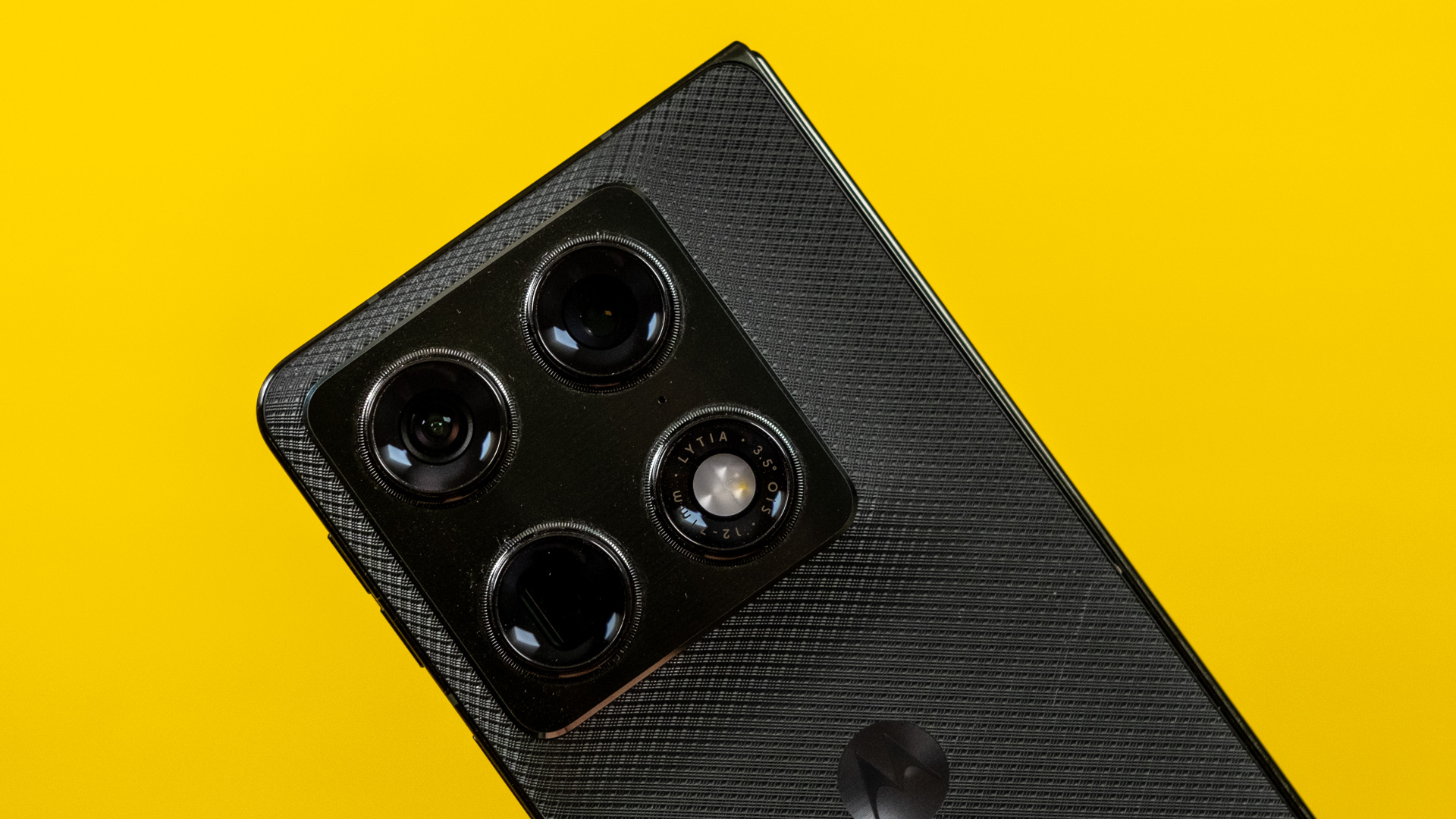
The Razr Fold has three 50 MP camera sensors.
Credit:
Ryan Whitwam
A long-standing issue with Moto’s cameras has been their slow shutter speed, which made it hard to capture moving subjects. The Razr Fold’s primary camera is noticeably faster. It’s not as capable as Google’s Pixel phones, but you still have a reasonable chance of getting a non-blurry shot of a wiggly kid or pet.

Ryan Whitwam
Bright outdoor light and shadows.
Ryan Whitwam

Outdoor light, fast movement.
Outdoor light, fast movement.

Ryan Whitwam
Shady outdoors.
Ryan Whitwam
Outdoor light, fast movement.
Shady outdoors.
Ryan Whitwam
Some photos I’ve taken with the Razr look undeniably great—they’re sharp, detailed, and well-exposed. In general, Motorola has also gotten better at handling wide dynamic range, bringing out details in both light and dark areas. Images are good in middling light, but Motorola’s night mode photography still trails the competition.
The improvements seem to come at the expense of processing time, though. The previews you see in the camera are often very different from what you get once all the optimization is done. And there are drawbacks to that, too. Some images can look very overprocessed, with oddly sharp edges and muddied fine lines. It’s a bit like those early Pixel HDR images that produced halos around objects.
Having high-resolution secondary sensors on a foldable is still not guaranteed, so it’s good to see Moto trying here. The 50 MP ultrawide captures a ton of detail, though processing can crush some of it in busy scenes. The 122-degree frame is pretty wide, but there’s very little edge distortion.


Ryan Whitwam
Primary wide lens.
Ryan Whitwam

Ryan Whitwam
3x telephoto.
Ryan Whitwam
Primary wide lens.
Ryan Whitwam
3x telephoto.
Ryan Whitwam
As usual, a 3x telephoto doesn’t provide much reach, but the Razr’s solid resolution gives you some leeway if you want to crop down for a better frame. It won’t look amazing, but you’ll be able to see what’s going on. However, the telephoto seems to be compensating for its narrower aperture by boosting colors in a way that looks a bit artificial.
No matter the device, $1,900 for a phone is a big ask. Foldables are not new, and after the better part of a decade, it’s clear these large-format devices won’t be getting cheaper. If anything, phones of all sizes are becoming more expensive due to escalating component prices. Is the functionality there to justify spending almost $2,000 on a phone?



Leave a comment